
Stuart Milanese Style Lace
c. 1610–1640
£8.00 per yd
Stuart Milanese Style Lace – Refined Elegance for the Stuart Court
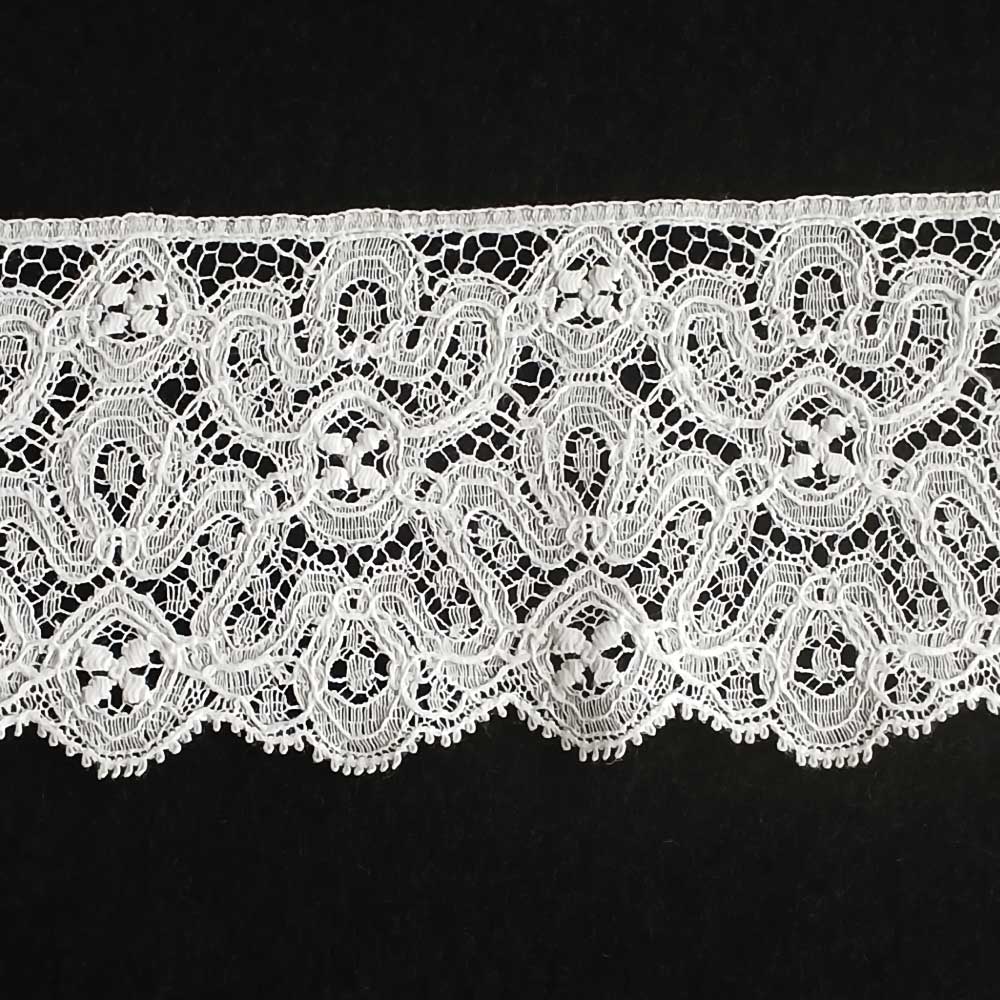
Bring 17th-century elegance to your needlework with this Milanese style lace inspired by the Stuart Era. Featuring delicate detail true to period design, it’s ideal for historical costuming, reenactment, or heirloom sewing projects. This 2 7/8″ (7.5cm) wide Stuart era-style Nottingham bobbin lace is inspired by authentic 17th-century designs. Perfect for Jacobean, Carolean and English Civil War reenactment. Resembling Milanese styles, this Stuart style lace accordingly brings period-accurate elegance to your costumes, perfect for designers, re-enactors, or couture artisans seeking authenticity.
Key features:
- Material Composition: 90% cotton, 10% nylon
- Width: 2 7/8 inch (7.5cm)
- Available in pure white
Sold per yard; multiple yards will be sent as one continuous length where possible
Perfect For:
English and continental European tailors used this lace in English and continental European fashion during the reigns of James I (1603–1625) and Charles I (1625–1649). Use this Milanese-style lace to trim, cuffs, falling bands, partlets and kerchiefs, especially for court dress, portraiture, and ceremonial wear. It is ideal for adding historically accurate Jacobean and English Civil War era detailing to theatre and film wardrobe or 17th century reproduction clothing.
Key Stuart Era Design Elements:
-
Scroll-like Motifs: The lace displays curving, vegetable scrolls, reminiscent of acanthus leaf elegantly interlocking. These organic, wave-like forms give the lace a fluid sense of movement.
-
Layered Dimensionality: The motifs are densely worked, with sections that appear raised or padded—creating a textural, three-dimensional effect that would catch light dramatically when worn.
-
Scalloped Lower Edge: The bottom edge is deeply scalloped, with looped or picot-like finishes, enhancing the sense of richness and elaboration.
This lace reflects Milanese bobbin lace traditions, which favoured flowing, naturalistic shapes over the geometric forms of earlier reticella. Despite its complexity, the design is carefully balanced and repeated with formal symmetry. In summary, this lace exemplifies luxury and captures the ornate sophistication of early Baroque textile design.
Standard Delivery 48hrs Royal Mail (UK Mainland) for orders under £100 (Mon – Fri)
Express Delivery 24hr Royal Mail (UK Mainland) (Mon – Fri)
Special Delivery Guaranteed by 1pm* Royal Mail (UK Mainland) for orders over £100 (Mon-Fri)
Both options are tracked
The cut-off time for orders is 11am. Orders placed after this time will be shipped the next business day.
FREE Standard delivery for Fabric Samples only – Via Royal Mail 2nd Class. Please be aware we CANNOT track orders sent with Royal Mail 2nd Class. For urgent orders, please use express shipping. Please allow up to two weeks for Royal Mail orders to be delivered.
Worldwide Shipping Available
Europe:
Standard Royal Mail International Tracked (3-5 working days)
Exact times may vary depending upon destination country
United States (mainland only):
Standard shipping Royal Mail International Tracked – (5-7 working days)
Express shipping UPS Express (2-3 working days)
All shipping is tracked
——————————-
As a small, family run company, we hand pick and pack your order, taking great care packing your order to ensure it gets to you in the same condition it leaves us.
Click here for more info